Untitled Document
 
Indigeneous Communities
Untitled Document
Social Doctors
in every country

Corporates &
CSR Brands


Corporate Foundations

Funding Agencies

Philanthropists

Celebrities

Your Birthday

Governments

NGOs &
NGO Brands


United Nations

Thane : Global example

Social issue exposure
Media
Business News
Corporate Media
Corporate Special
Industrywise corp
Namewise corp
MNCs
Global principles

Billions of users means Social responsibility,
Country responsibility &
Climate responsibility is far bigger
Products
Medicines
Each country has
social challenges
Governments
Political parties
Law Ministry
Police
Helplines
Bordering countries
Interesting facts
National Fruit
Botanical Gardens
Zoos
 
Country code
Domain code
Rivers
Forests
 
Nobel Laureates 
World Heritage pts
Celebrities
Industry Associations
28.08.2013
Thought birth date
"We cant change that"
Nobody in the last 2025 years was successful in changing attitude of people.

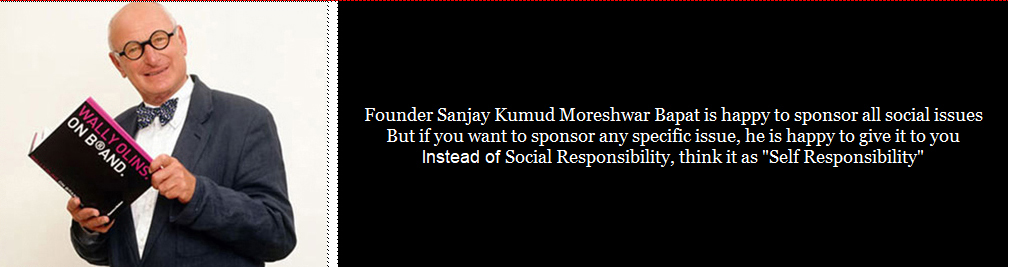
Maybe the thoughts came after 28.08.2013 when founder Sanjay Kumud Moreshwar Bapat had an almost fatal accident and his death was postponed by Bhau and many social doctors like Mastek Foundation, Adfactors PR, Venkat, not to be named philanthropist but these are thoughts.

By education he may be an Engineer and MBA, but his teacher is life.

He had the experience of meeting with Mr Ratan Tata, Keshub Mahindra or had a letter from film celebrity Amitabh Bachchan on his views of Developed Nation or call from former President Dr Abdul Kalam or many school or college friends who stayed at hospital after the accident.

He also experienced below third grade individuals who are motivating him to write a digital book on mental rape.

And he is also learning how to help people from his elder son Rohan, who is differently abled and can not do any main thing on his own.

So like everyone good and bad things happen but instead of blaming them, he is learning from them or their makers.

He worked in advertising and PR and social PR and that is why he thought he should use his skills in Branding issues.

And good things is he was part of Onida TV Team where in the ad they showed broken TV with tag line "Neighbours envy, owners pride"

He does not want to own because he knows he will leave the world empty. But while on earth, he should live with pride.

Governments
Law Ministry
Police
Helplines
Bordering countries


Phillipines
The houses built to survive floods
The Manobo indigenous people live and thrive on a vast wetland in the Philippines – despite dealing with dozens of storms and floods per year. What can we learn from them?


USA

AISES

Association on American Indian Affairs

Native American Rights Fund

American Indian College Fund

Native Americans in Philanthropy

Native Forward

Native Governance Center

American Indian Cancer Foundation

National Indian Child Welfare Association

Kwek Society Corp

First Peoples Fund

Koahnic Broadcast Corporation

Partnership With Native Americans

Phoenix Indian Center


Social and Economic Challenges:
Poverty and Inequality:
Indigenous peoples often experience higher rates of poverty, unemployment, and lack of access to basic services compared to non-Indigenous populations.
Discrimination:
Indigenous peoples face systemic discrimination in various aspects of life, including education, employment, and access to justice.
Land Rights and Dispossession:
Many Indigenous communities have been dispossessed of their ancestral lands and territories, leading to displacement and loss of traditional livelihoods.
Cultural Erosion:
Assimilation policies and the dominance of mainstream cultures threaten the survival of Indigenous languages, traditions, and knowledge systems.
Lack of Political Representation:
Indigenous peoples often lack adequate representation in political decision-making processes, hindering their ability to advocate for their rights and interests.
Incarceration Rates:
Indigenous peoples are disproportionately represented in prison systems, reflecting systemic biases and injustices.
Health Disparities:
Indigenous communities often experience poorer health outcomes, including higher rates of chronic diseases and lower life expectancies, due to limited access to healthcare and other social determinants of health.
Environmental Challenges:
Climate Change:
Indigenous communities, who are often highly dependent on their natural environment, are particularly vulnerable to the impacts of climate change, such as rising sea levels, extreme weather events, and resource scarcity.
Environmental Degradation:
Deforestation, pollution, and resource extraction activities can have devastating consequences for Indigenous communities and their traditional ways of life.
Loss of Biodiversity:
The loss of biodiversity and natural resources can threaten the livelihoods and cultural practices of Indigenous peoples.
Other Challenges:
Lack of Access to Education:
Indigenous children and youth often face barriers to accessing quality education, including lack of culturally appropriate curricula and language instruction.
Forced Relocation:
Indigenous communities are sometimes forcibly relocated from their ancestral lands, disrupting their social structures and traditional ways of life.
Cultural Appropriation:
The appropriation of Indigenous cultures and knowledge by non-Indigenous people can lead to the erosion of cultural identity and the exploitation of traditional practices.
Armed Conflict:
Indigenous peoples are often caught in armed conflicts, either as victims or as participants, further destabilizing their communities and undermining their rights.
Lack of Access to Justice:
Indigenous peoples often face barriers to accessing justice, including language barriers, lack of legal representation, and systemic biases in the legal system.


NGOs
countrywise

India

Afghanistan
Albania
Algeria
Andorra
Angola
Antigua & Barbuda
Argentina
Armenia
Australia
Austria
Azerbaijan

Bahamas
Bahrain
Bangladesh
Barbados
Belarus
Belgium
Belize
Benin
Bhutan
Bolivia
Bosnia & Herzegovina
Botswana
Brazil
Brunei
Bulgaria
Burkina Faso
Burundi

Cabo Verde
Cambodia
Cameroon
Canada
Central African Republic
Chad
Chile
China
Colombia
Comoros
Congo
Costa Rica
Cote d'Ivoire
Croatia
Cuba
Cyprus
Czech Republic

Democratic Republic Of The Congo
Denmark

Djibouti

Dominica
Dominican Republic

Ecuador
Egypt
El Salvador
Equatorial Guinea
Eritrea
Estonia
Eswatini
Ethiopia

Fiji
Finland
France

Gabon
Gambia
Georgia
Germany
Ghana
Greece
Grenada
Guatemala
Guinea
Guinea Bissau
Guyana

Haiti
Honduras
Hong Kong (SAR)
Hungary

Iceland
India
Indonesia
Iran
Iraq
Ireland
Israel
Italy

Jamaica
Japan
Jordan
Kazakhstan
Kenya
Kiribati
Kuwait
Kyrgyzstan
Laos
Latvia
Lebanon
Lesotho
Liberia
Libya
Liechtenstein
Lithuania
Luxembourg

Macau (SAR)
Madagascar
Malawi
Malaysia
Maldives
Mali
Malta
Marshall Islands
Mauritania
Mauritius
Mexico
Micronesia
Monaco
Mongolia
Montenegro
Morocco
Mozambique
Myanmar

Namibia
Nauru
Nepal
Netherlands
New Zealand
Nicaragua
Niger
Nigeria
North Korea
North Macedonia
Norway

Oman

Pakistan
Palau
Panama
Papua New Guinea
Paraguay
Peru
Philippines
Poland
Portugal

Qatar

Republic of Moldova
Romania
Russian Federation
Rwanda

Saint Kitts and Nevis
Saint Lucia
St Vincent And Grenadines
Samoa
San Marino
Sao Tome And Principe
Saudi Arabia
Senegal
Serbia
Seychelles
Sierra Leone
Singapore
Slovakia
Slovenia
Solomon Islands
Somalia
South Africa
South Korea
South Sudan
Spain
Sri Lanka
Sudan
Suriname
Sweden
Switzerland
Syrian Arab Republic

Tajikistan
Tanzania
Thailand
Timor-Leste
Togo
Tonga
Trinidad And Tobago
Tunisia
Turkey
Turkmenistan
Tuvalu

Uganda
Ukraine
United Arab Emirates
United Kingdom
USA
Urugway
Uzbekistan

Vanuau
Venezuela
Vietnam

Yemen

Zambia
Zimbabwe