Untitled Document
 |
28.08.2013
Thought birth date |
"We
cant change that"
Nobody in the last 2025 years was successful in changing attitude of people.
Maybe the
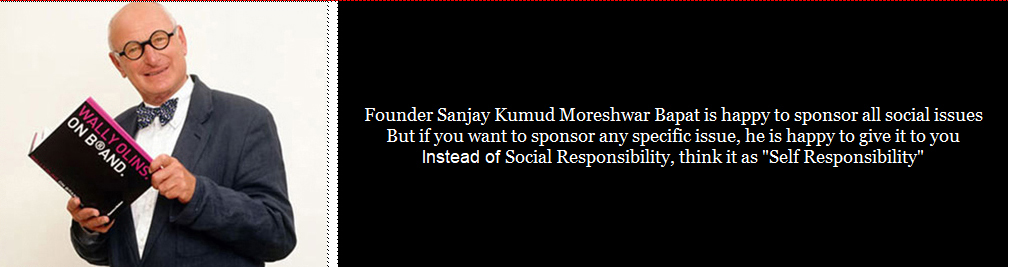
thoughts came after 28.08.2013 when founder Sanjay Kumud Moreshwar Bapat
had an almost fatal accident and his death was postponed by Bhau and
many social doctors like Mastek Foundation, Adfactors PR, Venkat, not
to be named philanthropist but these are thoughts.
By education he
may be an Engineer and MBA, but his teacher is life.
He had the experience of meeting with Mr Ratan Tata, Keshub Mahindra
or had a letter from film celebrity Amitabh Bachchan on his views of
Developed Nation or call from former President Dr Abdul Kalam or many
school or college friends who stayed at hospital after the accident.
He also experienced below third grade individuals who are motivating
him to write a digital book on mental rape.
And he is also learning
how to help people from his elder son Rohan, who is differently abled
and can not do any main thing on his own.
So like everyone
good and bad things happen but instead of blaming them, he is learning
from them or their makers.
He worked in advertising
and PR and social PR and that is why he thought he should use his skills
in Branding issues.
And good things
is he was part of Onida TV Team where in the ad they showed broken TV
with tag line "Neighbours envy, owners pride"
He does not want to own because he knows he will leave the world empty.
But while on earth, he should live with pride.
|
|
|
Corporate Foundations
India
Persistant
Foundation : Skill
development programs in urban and rural areas to empower
young men and women to obtain a sustainable source of livelihoo
NGOs
TNS
India Foundation
: Urban Livelihood Programmes
1. Infrastructure Deficiencies:
Inadequate Housing:
The rapid influx of people into cities often outpaces the
availability of affordable and decent housing, leading to
overcrowding, slums, and informal settlements.
Lack of Basic Services:
Many urban areas struggle with inadequate sanitation, clean
water access, electricity, and waste management, posing
significant health risks.
Transportation Problems:
Congestion, inadequate public transportation, and lack of
pedestrian-friendly infrastructure hinder mobility and economic
activity.
2. Environmental Degradation:
Pollution:
Industrial activity, vehicular emissions, and poor waste
management contribute to air and water pollution, impacting
public health and the environment.
Loss of Green Spaces:
Urban expansion often leads to the destruction of natural
habitats and green spaces, exacerbating environmental problems
and reducing the quality of life.
Climate Change Impacts:
Cities are particularly vulnerable to the impacts of climate
change, such as rising sea levels, extreme weather events,
and heatwaves.
3. Social and Economic Challenges:
Inequality and Poverty:
Urbanization can exacerbate existing inequalities, with
marginalized communities facing limited access to opportunities,
services, and resources.
Slums and Informal Settlements:
The growth of slums and informal settlements reflects the
failure to provide adequate housing and services for the
urban poor.
Crime and Social Instability:
Poverty, unemployment, and lack of opportunities can contribute
to increased crime rates and social unrest.
Lack of Planning:
Inappropriate planning policies can lead to suboptimal use
of land and resources.
Unclear lines of accountability:
Lack of independent regulatory authorities and a focus on
moving vehicles rather than meeting the needs of people
who walk or ride bicycles can lead to issues.
|
|
|
Untitled Document
Donate
the NGOs directly
Not through us |
| Fund or
donate directly to the concerned NGO. If you want to see whom to donate,
we share issuewise NGOs and also mention their country. Visit their website
and donate to them. |
| Focus
is limitation |
NGO
Social Doctors is our focus. We know there are millions of social doctors
in the world and focussing on NGOs would reduce the social doctors which
help communities, countries & climate. But we limit it to NGOs because
they need funds for their own survival and for helping communities more
in terms of numbers as well as in terms of geographical area.
Corporates have competition from other corporates. NGOs have competition
not just from other corporate donors which may look for other NGOs for whatever
good or bad reasons but that from funding agencies, corporate foundations,
philanthropists, celebrities and volunteers who may select other NGOs
In
2001, we invested time, money and talent of various corporates, funding
agencies to work on credibility of NGOs and realised two things.
1) It takes anywhere between 3 months to 6 months time to do research
on any 1 NGO because we have to do research with their donors, the communities
they serve, local people & employees of the NGO
2) When the founder or CEO of the NGO either leaves the world or the NGO,
then the NGO credibility affects manytimes in positive or negative direction
because new management will have their own working characteristics plus
the NGO Founder or CEO or team members are like family to the communities
and with their living, the NGO Credibility may get affected (again, in
positive or negative term)
Doing
research of thousands of NGOs from different countries is not something
any organisation can do (however large it is like 1000 people organisation
because they can neither give necessary salary to the talented people
not can they afford travel and stay cost of people from that organisation).
And it is always better to get local talent for not just cost of talent
and travel but they know the local lanauage which is essential to communicate
plus local humsn behaviour or local government plus
local politics which may have positive or negative effect
|
| Yog
Meditation |
| Thane
: Global example |
 |
Social issues need
Brand Surgery |
| People
like Brands.
Infact they love Brands.
Many people in the world hate "social issues". Maybe because
they think they have one life.
They want to enjoy.
And not get involved with
Social issues others face.
Please note "others face"
These people know must know that they came on earth alone and leave the
world alone. Their parents, life partner, children are all different than
themself. Even if it is twins or more together, they as individuals are
aline. And yes, maybe leave alongwith others in case of natural disasters
like flood, earthquake or or man made disasters like war, naxalism but
the fact is as government counts them as numbers like number of people
died in flood was 28813. Yes, they become a number however poor or rich
they were.
So what you do in between birth and death is important. You can be a great
film hero or sports heroine or super rich business person or born in royal
family or on streets in a poor family. You were born as a body and leave
as a body, what you live as a body is key.
|
|